Complying with regulations and protecting the environment should not mean increasing your operating costs. At BLUER, we help you achieve both.
Effective technologies for eliminating polluting emissions in industrial environments
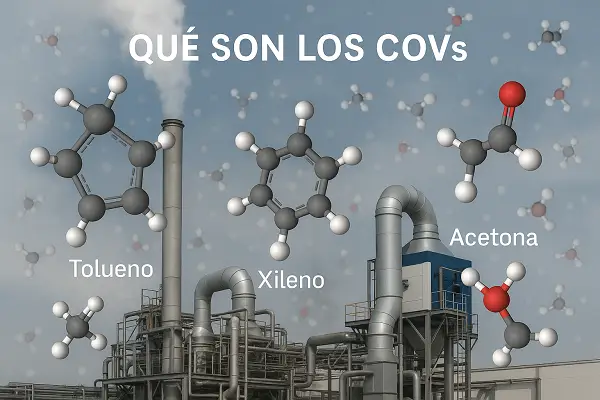
What are VOCs and why should they be treated?
Volatile organic compounds (VOCs) are chemical substances that evaporate easily at room temperature and, when emitted into the atmosphere, generate a significant environmental impact. They come from a wide variety of industrial processes: from the manufacture of paints, varnishes, and solvents to the chemical, pharmaceutical, automotive, and food industries.
In addition to their direct toxicity, VOCs contribute to the formation of tropospheric ozone and photochemical smog, so their emission is heavily regulated by regulations such as the Industrial Emissions Directive (IED) and sectorial BREF documents. Compliance with these requirements is mandatory, but also an opportunity to improve the sustainability and efficiency of industrial processes.
Hybrid systems with energy recovery: we combine technologies to maximize performance and reduce energy consumption, integrating heat recovery in industrial processes where feasible.
Custom engineering and comprehensive approach
Each industry, each process, and each emission composition is different. Therefore, our approach is based on personalized engineering, where we analyze the flow rates, chemical composition, operating conditions, and customer objectives to select and design the most appropriate solution.
In addition, we integrate energy diagnostic tools, operation automation, and emission data monitoring, ensuring not only regulatory compliance but also continuous improvement of the system.
In addition to their direct toxicity, VOCs contribute to the formation of tropospheric ozone and photochemical smog, so their emission is heavily regulated by regulations such as the Industrial Emissions Directive (IED) and sectorial BREF documents. Compliance with these requirements is mandatory, but also an opportunity to improve the sustainability and efficiency of industrial processes.
Hybrid systems with energy recovery: we combine technologies to maximize performance and reduce energy consumption, integrating heat recovery in industrial processes where feasible.
Key benefits of our VOC solutions
VOC removal with high efficiencies (>99%)
Adaptation to different sectors and process types
Guaranteed compliance with European and local regulations
Reduction of operating costs through energy recovery
Compact, modular, and scalable design
Technical support from design to operation
Do you want to know which solution is best suited for your process?
At BLUER, we help you evaluate your current system and propose technical, energy, and environmental improvements. Our engineering team specializes in the implementation of clean technologies and in adapting to the most demanding legal requirements.